

24/7 Live Call Answering
(470) 558-0495
24/7 Live Call Answering
(470) 558-0495If your loved one has been hurt in an Atlanta nursing home, you may be trying to make sense of how and why they experienced abuse, neglect, or mistreatment. At Andrew R. Lynch, P.C., our Atlanta, GA nursing home lawyer represents residents and families with the same intensity we bring to every serious injury claim. Andrew Lynch graduated cum laude from Georgia State University College of Law and has been fighting for injured clients across the Atlanta metro for 16 years. If you believe your loved one was harmed in a long-term care facility, contact us to schedule a free consultation.
Andrew Lynch has handled premises liability and personal injury cases throughout Georgia since building his practice over the past 16 years. He graduated from Georgia State University College of Law cum laude and completed the Bill Daniels Trial Advocacy Program, which is a selective program capped at 30 students that focuses on intensive jury trial training. That courtroom preparation makes a difference in nursing home cases, where facilities and their insurers routinely resist fair settlements.
Andrew focuses his practice on representing clients who have been hurt by the negligence, recklessness, or intentional harm of another. When nursing homes fail to properly care for their residents or inflict purposeful injury, they should be held accountable for such an offense. He understands how to build these cases and how to push them toward results. As a personal injury lawyer in Atlanta, GA, he brings that same approach to every nursing home negligence claim.
The firm has helped clients recover millions of dollars in judgments and settlements across a range of serious injury and premises liability cases. One case result specifically involving negligent nursing care and transportation in DeKalb County resulted in a $300,000 recovery. Andrew has been named to the National Trial Lawyers Top 100 Trial Lawyers in Georgia consistently since 2013, and has received the highest rating for legal ability and ethical standards from Super Lawyers. He was also recognized as a Georgia Super Lawyer in 2022.
Andrew is also a member of the National Trial Lawyers Association and received a peer review rating from Martindale-Hubbell. He is a member of the Decatur Rotary Club, Decatur County Bar Association, and served as Former President of the DeKalb Bar’s Young Lawyers Division.
We handle nursing home cases on a contingency fee basis. You pay nothing upfront and zero out of pocket unless we recover for you. Families dealing with a loved one’s injury or death shouldn’t have to worry about legal fees on top of everything else. These cases can be particularly sensitive in nature, so we use both our compassion and strategy to get results for victims and their families.
⭐⭐⭐⭐⭐
“I’m currently working with Attorney Andrew Lynch on my son’s injury case, and I’m very happy we chose him. He’s empathetic, responsive, and knowledgeable, and always takes time to keep us informed. His staff is also friendly and helpful.” — Y.R.
Read more reviews on our Google Business Profile.
Nursing home liability takes many forms. What they share in common is a facility’s failure to meet its duty of care to a vulnerable resident. We handle claims involving:
Georgia law gives nursing home residents specific rights and protections. We can help you understand whether any of these legal requirements for nursing home cases apply to your situation.
The Bill of Rights for Residents of Long-Term Care Facilities (O.C.G.A. § 31-8-100 et seq.) establishes that residents are entitled to dignity, appropriate care, freedom from abuse, and the right to raise complaints without retaliation. Per the Georgia General Assembly’s official code, violations of these rights in the statute can form the basis for a civil negligence claim.
The Resident Abuse Reporting Act (O.C.G.A. § 31-8-82) requires mandated reporters, including facility administrators, nurses, physicians, and social workers, to immediately notify of any known or suspected abuse or exploitation to the Georgia Department of Community Health. Failure to report is itself evidence of systemic failures that can strengthen a civil case.
Georgia’s elder abuse criminal statute (O.C.G.A. § 16-5-102) makes it a felony to willfully exploit, physically abuse, or deprive a disabled adult or elder person of essential services. A person convicted under this statute faces up to 20 years in prison. Criminal charges against a staff member don’t bar you from bringing a separate civil claim, in fact, a criminal case can support yours.
The statute of limitations is one of the most important deadlines in any nursing home claim. Under O.C.G.A. § 9-3-33, personal injury claims, such as those arising from nursing home negligence, must generally be filed within two years of the date of injury. Wrongful death claims follow the same two-year period, starting from the date of death. Missing this deadline can cause you to completely lose your ability to pursue compensation. There are limited circumstances where the statute of limitations wouldn’t be in effect, but we don’t recommend counting them.
Georgia law permits several categories of compensation in nursing home negligence and abuse claims. What’s available in your case depends on the specific facts, but the framework is consistent.
Economic damages cover measurable financial losses directly caused by the facility’s negligence. These include past and future medical expenses, such as hospitalizations, wound care, surgeries, rehabilitation, costs of transferring to a different facility, and any out-of-pocket expenses the family incurred as a result of the injury or death.
Non-economic damages address the harm that doesn’t show up on a medical bill. Pain and suffering is the most significant category. An example of this would be a resident who develops severe pressure ulcers from being left immobile for hours and experiences profound physical suffering. An elderly person who is physically abused by someone they depend on for care can suffer from deep psychological harm. Georgia law allows recovery for physical injuries and mental anguish. Families pursuing wrongful death claims may recover for the full value of the deceased’s life and not just lost income, but the loss of companionship, guidance, and relationship.
Punitive damages are available in cases where the conduct was particularly egregious, such as willful misconduct, malice, or reckless disregard for a resident’s safety. Georgia courts award these to punish the facility and deter similar behavior from happening in the future. When a nursing home ignored documented complaints about an abusive staff member and allowed the harm to continue, punitive damages may be warranted. Under Georgia’s modified comparative fault rule (O.C.G.A. § 51-12-33), the amount of recovery may be reduced if the resident shares some responsibility, but full recovery is available if you are less than 50% at fault.
If you’re not sure what your case is worth, that is what we can discuss with you during a free consultation. What happened to your loved one, and what the facility knew or should have known, drives our analysis when pursuing justice.
If you believe a nursing home in Atlanta failed in providing for your loved one’s care, we want to hear from you. Bedsores, unexplained falls, sudden weight loss, and infections that went untreated, these aren’t unavoidable parts of aging. They’re often signs of neglect. We offer free consultations for nursing home abuse cases and work on a contingency basis, meaning there are no fees unless we recover. Contact us to schedule your consultation and get more information about what to do for your loved one’s wellbeing and protection.
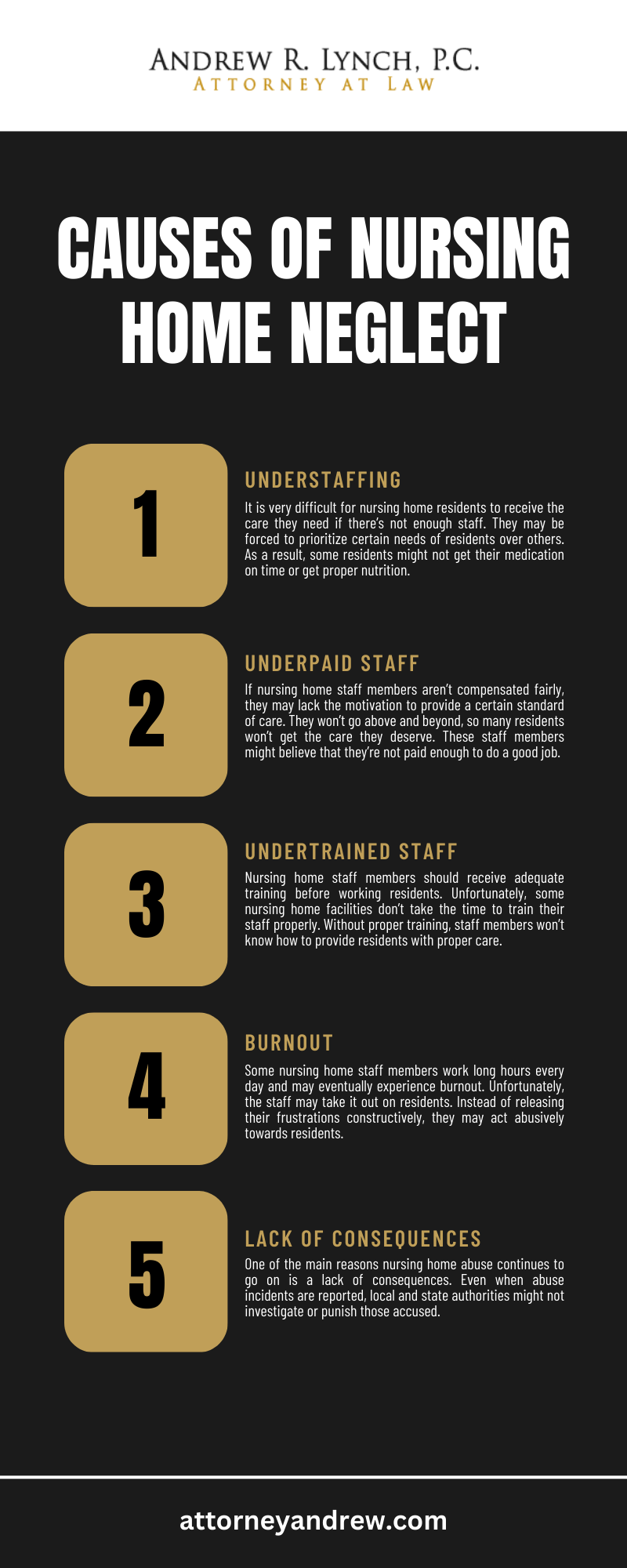
 Roughly 1.2 million people live in nursing homes nationwide, according to CDC data, and a large share depend entirely on staff for food, medication, hygiene, and mobility. That dependence is exactly what makes residents vulnerable when a facility cuts corners. Atlanta families place their trust in these homes every day, and when that trust is broken, the harm can be severe and, in some cases, permanent.
Underreporting is the reason these figures understate the crisis. Residents with dementia may be unable to explain what happened. Others stay silent out of fear, shame, or worry that reporting will cost them their care. Because so much goes unseen, a change in a loved one’s health, mood, or finances is often the first real signal that something is wrong.
Acting quickly protects your loved one and preserves the proof a claim depends on. If you believe a resident is being abused or neglected, these are the steps that matter most.
Nothing upfront. We take nursing home cases on a contingency basis, so you pay no attorney fees unless we recover money for your family. The first consultation is free. This structure exists so that families dealing with a loved one’s injury can get answers without adding a legal bill to everything else they are managing.
More than one party is often liable. The facility itself can be responsible for understaffing or poor training. Individual staff members can be liable for direct abuse. A corporate parent that set impossible budgets, or a staffing agency that placed an unqualified worker, may share the blame. Part of our job is identifying every party whose choices contributed to the harm.
Call anyway. Families rarely have documentation when they first sense something is wrong, and you are not expected to. A gut feeling backed by a change in your loved one’s weight, mood, or hygiene is enough to start. We handle the investigation, request the records, and bring in medical professionals to determine whether neglect or abuse occurred.
Yes. When a facility’s neglect or abuse contributes to a resident’s death, Georgia law allows surviving family members to pursue a claim for that loss. These cases can also fall under crime victim compensation when criminal conduct was involved. We handle both the civil claim and coordination with any criminal investigation.
It depends on the severity of the injury and whether the facility negotiates in good faith. Some claims resolve in months once the records confirm what happened. Others require a filed lawsuit and take longer, especially when a corporate owner fights liability. We prepare every case as if it will be tried, which often moves an insurer toward a fair number sooner.
That defense is common, and it is not the end of your case. Facilities frequently argue that a bedsore, infection, or fall was an unavoidable result of aging. Medical records and an independent review often show otherwise, that the harm was preventable and tied to specific failures in care. We build cases around that evidence, not the facility’s excuses.
Yes, and their safety comes first. Moving a resident to a safer home does not weaken a claim, and it does not erase what already happened. Keep copies of records from the original facility before the transfer. The costs of relocating can also become part of the damages we pursue.
Federal and state inspections are public. The Medicare Care Compare tool rates every certified nursing home on staffing, health inspections, and quality measures, and it lists recent citations. Reviewing a facility’s record can reveal a pattern of problems that supports your concerns and helps you make a safer choice going forward.
Often, no. Many nursing home claims settle once the evidence is clear. If a facility refuses to offer fair compensation, we are prepared to file a lawsuit and try the case. We keep you informed at each step so that decisions about settling or proceeding are always yours to make.
If you suspect abuse or neglect in a licensed facility, these Georgia agencies investigate complaints and advocate for residents. Contacting them creates an official record and can prompt an inspection.
Disclaimer: These organizations are listed for your convenience only. Andrew R. Lynch, P.C. does not endorse, and is not affiliated with, any of them, and we make no guarantee about the services they provide.
Andrew R. Lynch, P.C. is based in Decatur and represents injured residents and grieving families across the greater Atlanta metro. The firm was built around one focus: holding negligent parties accountable when their carelessness harms someone who trusted them for care. That record includes a $5.3 million recovery in a premises liability case against an apartment complex that failed to keep the people on its property safe, the same kind of accountability we pursue against long-term care facilities. For families whose loved one cannot travel, we come to you. If an injury or a hospital stay keeps you from reaching our office, we can meet you where you are, often within a day or two of your call.
⭐⭐⭐⭐⭐
“Andrew Lynch is a fantastic trial attorney. He works hard to achieve the best results for each of his clients. I have referred a number of individuals to him for their catastrophic personal injury cases and every person has repeatedly thanked me for recommending that they place their trust in Andrew.”
Mindy P.
Read more reviews on our Google Business Profile.
If you believe a nursing home has harmed your loved one, we want to hear your story. We offer a free consultation and take nursing home abuse cases on a contingency basis, which means no fees unless we recover for you. During that first conversation, we will listen to what happened, explain whether it may support a claim, and lay out the next steps. Contact us to speak with our office about protecting your loved one and holding the facility accountable.